
Community Member Profile: Judith
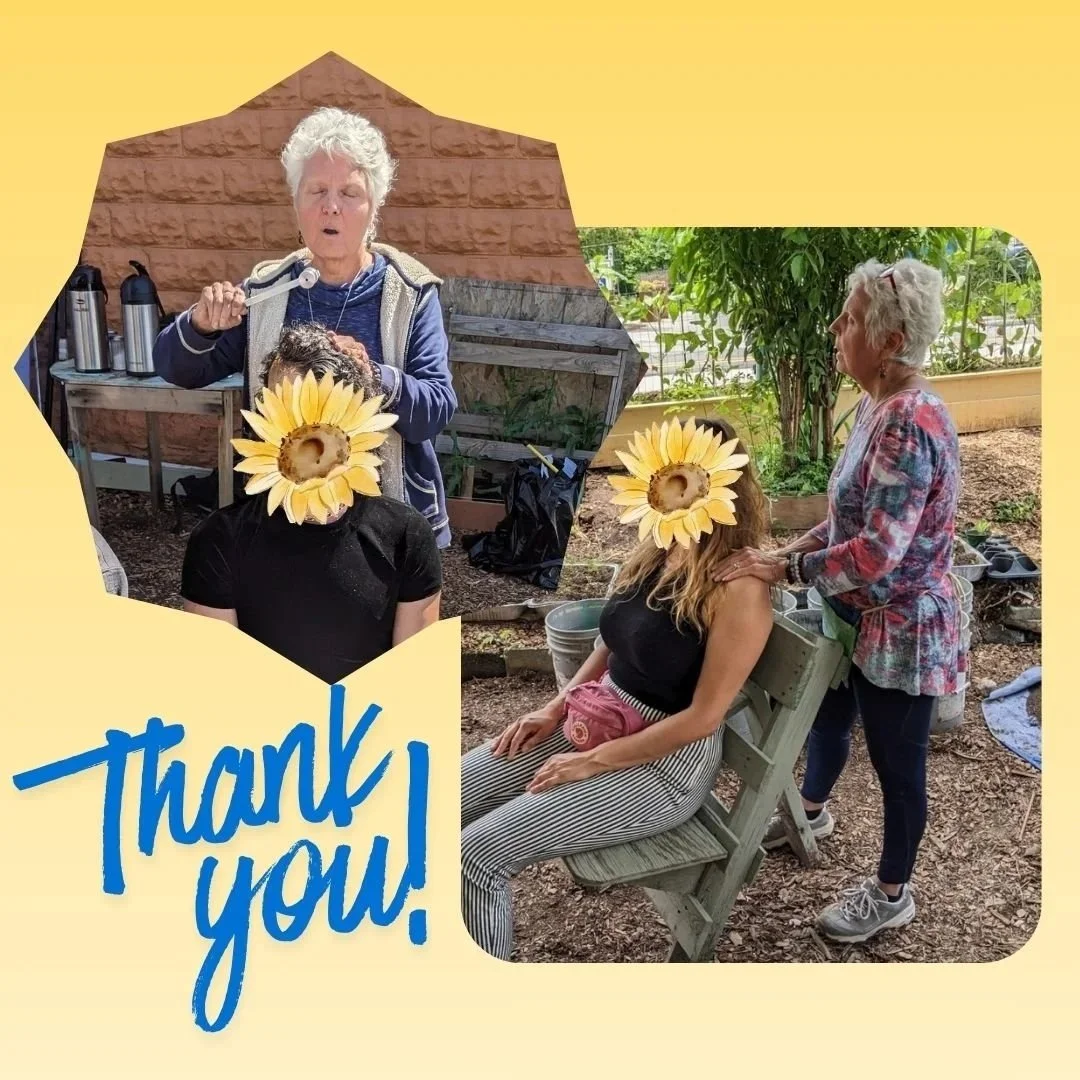
Grounding into Power: A conversation with Judith at 12 Baskets Cafe
By Ellie Strohm
When I met Judith in the garden where she often does her energy work, she didn’t open with technique or theory about Reiki. She opened with forgiveness. To her, it isn’t a lofty virtue or a soft cliché; it’s a practical, energetic shift that clears the path forward. “Forgiveness is the greatest gift you give yourself,” she said enthusiastically, “People hold grudges - of course they do. But the person you’re mad at often doesn’t even know, and it’s you who carries the weight.”
What unfolded during our conversation wasn’t a how-to on Reiki so much as a philosophy of living that complements the practice. Judith, who offers Reiki and spiritual guidance to anyone who walks in, believes that the energetic residue of old wounds doesn’t simply sit still - it broadcasts. “The grudge you have against the old boss or the teacher puts out a frequency,” she explained. “When the time is right, the world mirrors it back. Then one day you say, ‘Why do people always treat me this way?’”
She doesn’t mean forgiveness as erasure. “You don’t have to forget,” Judith said. “You just truly forgive. When you do, your perception shifts, and the same memories show up with new meaning.” She told me a story from her own life, an example she returns to when she’s helping others loosen their grip. In a past job Judith recalls reporting to a boss who pushed unfair discipline and played favorites. The experience was painful at the time, a source of resentment she carried into her next steps. Only later, through forgiveness, did she see it differently.
“If she hadn’t treated me that way, I wouldn’t have left,” Judith said. “And I ended up in a job I loved - one that fit me so well it was a joy to go to work.” Even now, she hasn’t forgotten the specifics of how she was managed. What’s changed is the story she tells herself about it. “She became a blessing. I just couldn’t see it until I forgave.”
Judith is clear-eyed about the process. In her experience, the universe likes to “tap you on the shoulder” after a big release. “It’ll show you the same theme in a smaller way, like it’s asking, ‘Are you sure you meant that?’” She doesn’t present this as cosmic punishment - more like an echo or a final check. “It’s happened to me more than once,” she said, laughing at the pattern. To her, these moments are opportunities to affirm the new choice, to respond from clarity instead of habit.
Clarity is a word she returns to often. The more she has forgiven and released, the more she feels steady in her relationships. “I rarely have issues with people now,” she told me. “When you’re clear, you stop broadcasting the old frequency. The world meets you where you are.”
If forgiveness is one part of the work, unhooking from an overdeveloped personal “story” is another. Judith sees this everywhere, particularly when people begin to define themselves by the worst thing that happened to them. “Story just makes more story,” she said gently. “It never stops if you feed it. It becomes a person’s identity.” She’s careful to say this doesn’t mean the pain wasn’t real or isn’t real. What she encourages is a change in approach: “Make a different choice. If you keep doing the same thing, you’ll keep getting the same result. Sometimes that means leaving a person, moving, changing jobs - or just starting by speaking differently about what’s happening.” For many, she said, that shift in language is enough to begin a new trajectory.
Judith’s path to the way she practices now has been a steady evolution. She began with what she calls “normal Reiki”- hands-on energy work focusing on relaxation and balance. But volunteering at 12 baskets changed her rhythm and her emphasis. The space is busier, the needs more immediate. The chaos of life leaks in through the door. In response, her sessions have become more empowering and more directive.
“Here, I focus on giving people their power back,” she said. “When they’re not paying, they tend to listen,” she added with a wry smile. “And I can be pushy - in a good way.” If someone feels even a small shift in their body - a lightness in the chest, a softening in the throat - they pay attention. Judith uses that opening to teach: awareness of breath and sensation, how to notice when anger rises, when the jaw tightens, when the shoulders climb. She talks about the body in energetic terms, about roots rustling down into the earth and channels opening through the crown, the third eye, the throat, and the heart. In an ideal session, she aims to reach down to the solar plexus - the seat of personal power - because once that pathway is clear, intention can do its work.
“Where your attention goes, your energy flows,” she said. If you spend your day ruminating on slights or doomscrolling the latest outrage, you are, in her view, feeding the very experience you most want to escape. She’s not condemning technology; she’s critiquing the feedback loop. “What you keep focusing on keeps getting fed,” she told me. Her antidote is deliberate attention: presence in the body, gratitude practices that feel genuine instead of forced, and the daily discipline of choosing different language, even in small ways.
Judith doesn’t promise a miracle in every session. She’s allergic to overpromising. But she knows what it feels like when a person lets go, even a little. “Something lifts,” she said, motioning upward with both hands. “You can almost hear the room exhale.” Those are the moments she lives for- the micro-releases that accumulate into a less burdened life, the fresh room inside a ribcage that allows someone to say, “Okay. Maybe I can try this another way.”
Her work at 12 baskets cafe has turned her from a practitioner into a partner. She doesn’t want clients who lie down, receive, and leave unchanged. She wants co-creators. “I’m handing you empowerment,” she tells me. In the weeks since our conversation, I’ve noticed how much of her language has quietly woven itself into my own awareness. During my sessions with Judith, the grounding she speaks of isn’t abstract - it’s physical and immediate, a steadying drop from my racing thoughts into the weight of my body. I’ve begun to catch the subtle broadcasts she describes: the way a lingering frustration tightens my chest, or how shifting my attention to breath and gratitude softens the edge. The more I practice this return to center, the more I understand what she means by clarity. It isn’t perfection or constant calm, but a growing ability to choose my response instead of reliving an old story. In that sense, our interview didn’t feel like an ending but an invitation - to keep forgiving, keep noticing, and keep rooting down into myself so that whatever I send out into the world carries a little more steadiness and a little less weight.
