
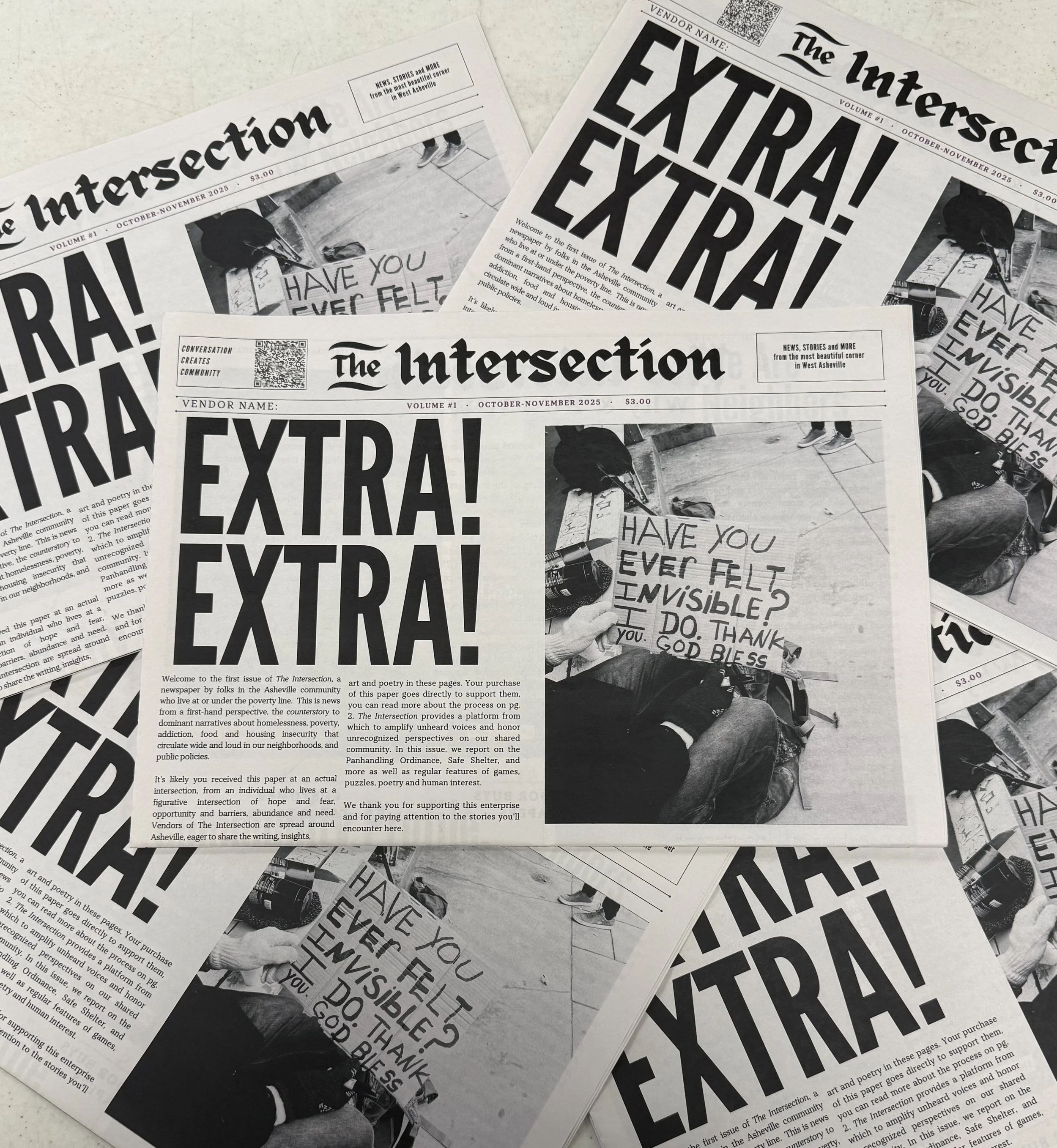
The AVL Street paper
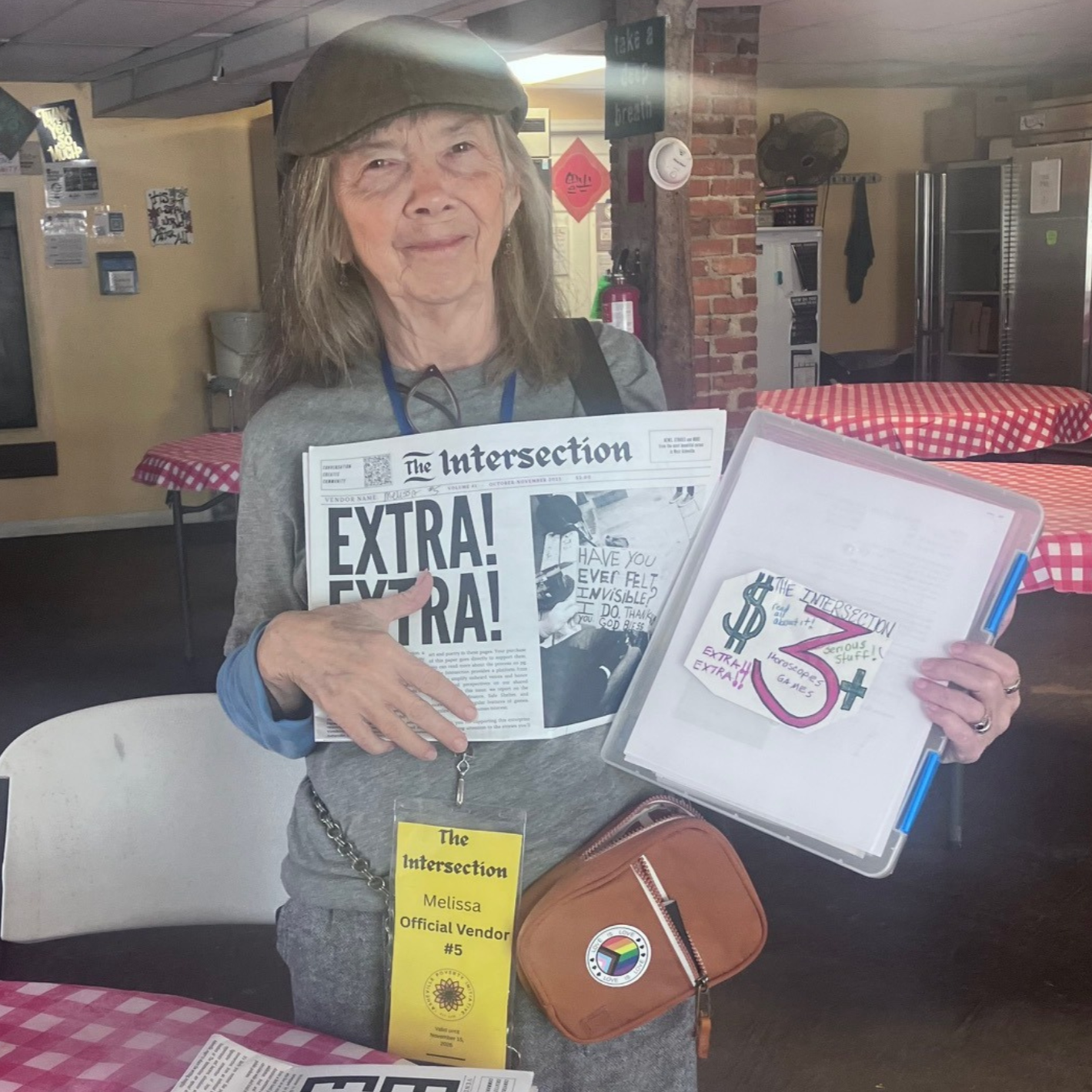
The Intersection is a physical print newspaper founded, published and supported by the community of Asheville Poverty Initiative. It can be exclusively found from vendors in the streets of Downtown and West Asheville. To locate vendors, keep up with our social media for weekly updates, or simply look out for them when you’re out and about!
Learn more below about how this project opens up employment opportunities for unsheltered people, the history of street papers, how they operate, and what they contain.
By the people, For the People
-
By the people, for the people, worldwide independent newspapers like ours are pioneered by the sidewalks and the street corners. Unsheltered and marginalized individuals are centered in this form of press, as they are the vendors and often contributors. Stories and other media are collected, formatted and printed by a team of organizers at API. From there, vendors purchase papers for $1 to cover supply costs and sell them for $4, keeping the profit, thus effectively starting their own small business.
This creates a viable employment opportunity for people who are otherwise turned away for lack of address or general discrimination. It also exists as a response to Asheville’s controversial panhandling ordinance, giving our most poverty stricken neighbors a legal method to acquire the financial means necessary to survive in this country.
-
The Intersection is the local beginning in a long-standing, international tradition of street papers. Driven by the sidewalks and the street corners, the modern street paper is a movement defined as a tangible combatant to homelessness. Over 100 different cities in 30 different countries have adopted this model, and we at API, after extensive planning and research, are proud to share that we are bringing it home.
There is a rich history in this practice of alternative, dissident and underground form of media, with the earliest editions tracing all the way back to 1879, with The Salvation Army’s paper, The War Cry, which was followed by union worker and religiously affiliated social justice newspapers such as The Catholic Worker.
The origins of the movement's current model began with New York City’s Street News and San Francisco’s StreetSheet. Both were launched in 1989, as a direct response to the war on drugs and mainstream, political stereotyping of the homeless population as drug-addicted and criminal, stereotypes which persist to this day.
Now, there is an International Network of Street Papers, the INSP, whose vision we share, as they define on their website: “People living in poverty have opportunities to earn an income and have their stories heard and understood.” This directly speaks to API’s mission of poverty education and brings a new outlet for our hands-on community work to grow.
-
While of course the main goal and focus is providing employment opportunities to those most affected by poverty, the scope of this mission only grows deeper. This paper invites people who are experiencing homelessness to learn job skills, to use their voices and share their stories, and to build connections within the community.
Beyond that, it brings a new, alternative media outlet, revolving around the streets we travel every day. Traditional media seems to center the sensational– the tech giants, the celebrities, the national politics, the crime. It relies on the most shocking headlines, to generate the most clicks, to generate the most profits. Our paper exists as the antithesis of this.
Our paper aims to empower– the vendors, the writers, the local organizations/businesses, and especially its readers. Through educating about our neighbors, our support systems, and our issues, we can effectively foster a sense of solidarity in our communities. Now more than ever this is critical. In a world where attention is a commodity, being intentional about it is powerful. What better to pay attention to than the only area each and every one of us has the ability to impact?
Uncensored, no click-bait, no fear-mongering. We are prioritizing in-person connection and keeping print media alive in a very disconnected digital age.
-
Local news, exclusive interviews
Social justice issues and Op-eds
Aid education
Information and education pertaining to homelessness and homeless issues
Creative works and poetry from our home writing group, Moonlight Cheese Alliance
Intentional classifieds: advertisements for local businesses who we support, and who support us
Astrology
Puzzles and games
And More!
Donate Directly →

Article Teaser
-
We are living in an increasingly divisive society. The larger political tension seems to grow more aggressive, media is almost exclusively told through biased lenses. Social media has fostered hyper-individualism and bubbles of moral superiority. The general technological evolution gave us the ability to do almost everything without leaving our homes, and the pandemic accustomed us to isolation. The modern world has created an antithesis to our biology as social creatures. This is not done without intention. We become reliant on the systems that are inherently exploitative- focused on squeezing every cent out of us instead of the wellbeing of society. Focused on keeping us discontent and angry so we are looking left and right instead of looking up.
There is in fact a logical resistance to this artificially manufactured disconnect, and it begins as simply as returning to the connection that has carried humanity since its creation. Returning to the village, returning to our tribal nature, returning to our neighbors. A better world is not going to begin from the top down. We must start here. We must create the world we wish to live in around us. Through finding community, we can build new systems to rely on. Systems built by the people, for the people. Systems with compassion in mind, systems with integrity, systems built to connect us to our natural being instead of dragging us further away from it.
Asheville is already a hot spot for this. Think back to Helene. In the immediate aftermath, the general sentiment was that we felt mostly abandoned by the government. But we, the people, showed up. Church groups and drug dealers, anarchist organizations and hillbillies, everyone came together. Our citizens are the reason the city stayed running, the ones who helped rebuild homes, who distributed emergency supplies, the ones who unblocked roads and donated to those who needed it the most. During that time we were all outside, offline, and mutual aid was everywhere. The government just imposed a curfew and sent the military to maintain fear based control. Threw a little bit of money our way, nothing nearly enough, and called it a day. We kept each other okay. Through this, we already proved what we are capable of.
Community means that we will survive when traditional systems wobble. It means that we can thrive in spite of imposed scarcity. In our city, organizations for this purpose already exist. API with 12 Baskets is a pillar example of this, biased as it may be to include, but it still runs true. Food for anyone who needs it, kindness and open arms, creative groups and members across every demographic you can think of. There’s also Pansy Collective, Asheville Survival Program, and Mutual Aid Wellness Collective, to name a few. When we educate ourselves about these groups and the individual purposes they serve, even if we ourselves don’t need their services right now, it gives us the ability to make connections when someone around us eventually does need them. If you don’t know where to find community, many of these organizations have volunteer opportunities, workshops, events, and other ways to get involved. A good starting place to learn about this kind of thing is here- this very paper you are holding right now. Also, on our Instagram we make efforts to consistently repost whatever mutual aid opportunities we see.
By Elle Chestnutt - To be featured in the Feburary-March Issue
Thanks to our sponsors!
Email us at theintersection@ashevillepovertyinitiative.org to inquire about becoming one.


Advertising in The Intersection is an affordable way to support economic opportunity, amplify local voices, and reach a values-driven audience. Ad options start at $25, with discounts for multi-issue and year-long commitments.
*We are currently accepting ads for the April/May issue! DEADLINE: 3/23/2026